


What will classrooms look like in five years? The answer involves AI far more than most people expect. Technology reshaping education today represents just the beginning. The transformation accelerating now will fundamentally redefine how humans learn.
- Advanced personalization tailors curriculum and pacing to individual goals, prior knowledge, and interests for improved mastery.
- AI tutors reach near-human instructional quality, offering Socratic dialogue, misconception diagnosis, and metacognitive coaching.
- Immersive AI with VR/AR creates virtual labs, historical immersion, and realistic skill simulations for experiential learning.
- Assessment shifts to continuous, authentic evaluation tracking learning processes, competencies, and employer-aligned validation.
- Equity, privacy, and quality governance are critical to ensure inclusive access, data protection, and evidence-based effectiveness.
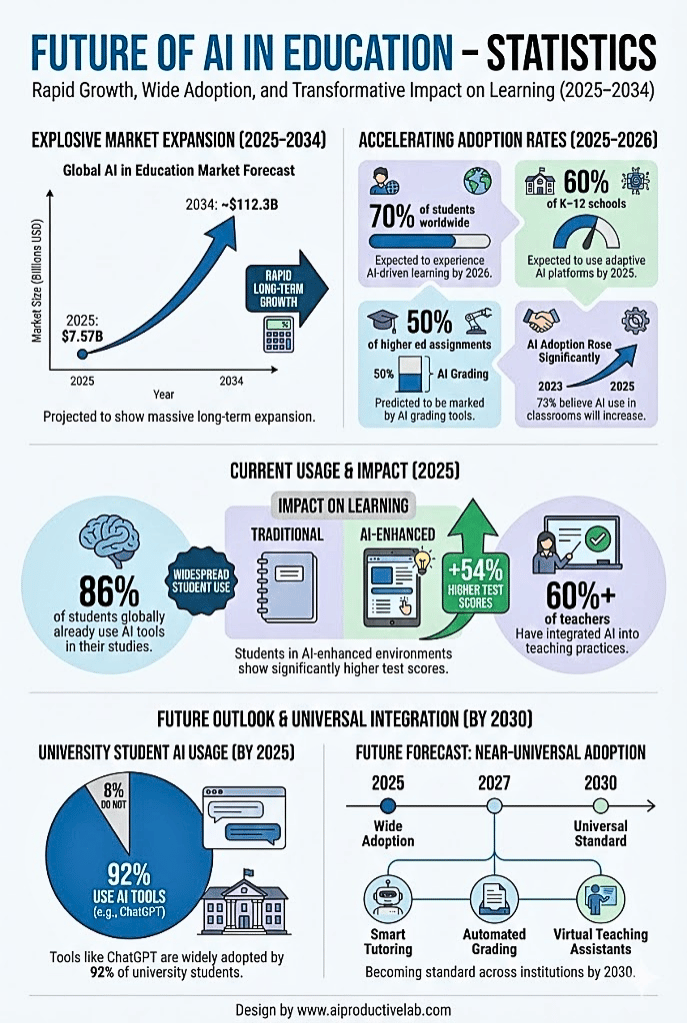
The numbers tell a compelling story. According to Grand View Research, the global AI in education market was valued at 5.88 billion USD in 2024. That figure is projected to reach 32.27 billion USD by 2030. This represents a compound annual growth rate of 31.2%—among the fastest-growing technology sectors globally.
The future of AI in education extends beyond market growth. New capabilities emerge monthly. Personalized AI tutors approach human-level instruction quality. Predictive systems identify learning challenges before students struggle. Immersive technologies create experiences impossible in traditional classrooms.
Predictions suggest AI tutors will become standard in public schools by 2026. Every student may soon have access to individualized instruction previously available only through expensive private tutoring. The democratization of quality education becomes genuinely possible.
This guide explores the future of AI in education comprehensively. You will learn emerging trends reshaping learning technology. You will understand timelines for key developments. You will see how organizations can prepare for coming changes. Most importantly, you will gain strategic insight for positioning your institution or business in this rapidly evolving landscape.
Market Growth and Investment Trajectory
Explosive Expansion Through 2030
The AI education market grows faster than nearly any technology sector. Investment pours into solutions addressing persistent educational challenges.
Market growth drivers include:
- Personalization demand: Learners expect individualized experiences
- Teacher shortage crisis: AI helps address staffing gaps
- Cost pressure: Technology delivers quality at lower per-learner costs
- Remote learning maturation: Online education requires intelligent support
- Corporate training expansion: Workforce development needs scalable solutions
The 31.2% compound annual growth rate means the market approximately doubles every 2.5 years. Organizations investing now position themselves ahead of accelerating adoption curves.
Regional Development Patterns
AI education adoption varies across global markets:
- North America: Leading adoption with strong EdTech investment
- Asia Pacific: Fastest growth rates driven by massive student populations
- Europe: Strong institutional adoption with regulatory emphasis
- Middle East: Significant government investment in educational transformation
- Latin America: Emerging markets with growing mobile learning adoption
Regional differences create opportunities for organizations understanding local contexts and needs.
Emerging AI Education Technologies
Advanced Personalized Learning Systems
Current adaptive learning represents early-stage technology. Future systems will understand learners far more deeply and adapt far more precisely.
Emerging capabilities include:
- Cognitive modeling: AI understanding individual thinking patterns
- Emotional recognition: Systems detecting frustration, confusion, or boredom
- Learning style optimization: Content presentation matching cognitive preferences
- Knowledge graph personalization: Individual maps of understanding and gaps
- Predictive path optimization: Algorithms forecasting optimal learning sequences
These advances move personalization from content difficulty adjustment toward genuine understanding of individual learners as unique cognitive beings.
AI Tutors Approaching Human Quality
AI tutoring systems improve rapidly. Natural language capabilities enable increasingly sophisticated instructional dialogue.
Future tutoring capabilities include:
- Socratic dialogue mastery: AI guiding discovery through strategic questioning
- Misconception diagnosis: Precise identification of understanding errors
- Multiple explanation strategies: Trying different approaches until concepts click
- Metacognitive coaching: Teaching students how to learn more effectively
- Motivational calibration: Encouragement matched to individual psychology
Predictions suggest AI tutors may achieve parity with human tutors for many instructional contexts by 2028. Some specialized domains may reach this milestone sooner.
Immersive Learning Experiences
Virtual and augmented reality combine with AI to create unprecedented learning environments.
Immersive education capabilities include:
- AI-guided virtual labs: Science experiments without physical constraints
- Historical immersion: Experiencing past events through intelligent simulation
- Language practice environments: Conversational AI in culturally accurate settings
- Skill simulation: Practice in realistic professional scenarios
- Collaborative virtual spaces: AI-facilitated group learning across distances
The combination of AI intelligence with immersive technology creates experiences no traditional classroom can replicate.
Multimodal AI Understanding
Future AI systems will understand learning across multiple channels simultaneously.
Multimodal capabilities include:
- Voice and text integration: Seamless conversation across communication modes
- Visual learning analysis: AI understanding diagrams, sketches, and demonstrations
- Gesture recognition: Systems interpreting physical interactions
- Attention monitoring: Understanding where learners focus
- Collaborative dynamics: Analyzing group interaction patterns
This comprehensive understanding enables AI to support learning however it naturally occurs.
Transformations in Educational Practice
The Evolving Teacher Role
AI will not replace teachers. Instead, technology transforms what teaching means and requires.
Future teacher roles include:
- Learning designer: Creating experiences AI delivers and supports
- Mentor and coach: Providing human guidance AI cannot replicate
- AI orchestrator: Directing intelligent tools effectively
- Relationship builder: Nurturing connections sustaining student motivation
- Critical thinking facilitator: Leading discussions developing reasoning skills
Teachers become more important, not less. Their role elevates from content delivery to capabilities only humans provide.
Assessment Revolution
Traditional testing faces fundamental transformation. AI enables continuous, authentic evaluation impossible through conventional methods.
Future assessment capabilities include:
- Process evaluation: Assessing how students learn, not just outcomes
- Authentic performance tasks: Real-world application evaluation
- Continuous competency tracking: Understanding without formal tests
- Credential verification: Blockchain-secured skill documentation
- Employer-aligned validation: Assessment matching workplace needs
The shift from periodic testing toward continuous understanding changes student experience fundamentally.
Curriculum Personalization
Standard curricula assumed all students need identical content. AI enables curriculum adaptation to individual goals, interests, and contexts.
Curriculum personalization includes:
- Career-aligned pathways: Learning sequences targeting specific professions
- Interest integration: Academic content connected to student passions
- Prior knowledge recognition: Credit for existing competencies
- Pace flexibility: Progression based on mastery, not time
- Context relevance: Content adapted to local circumstances and cultures
Every student receives curriculum optimized for their unique situation and aspirations.
Challenges and Considerations Ahead
Equity and Access Concerns
AI benefits must reach all learners, not only privileged populations.
Equity challenges include:
- Digital divide persistence: Not all students have adequate technology access
- Algorithmic bias risks: AI may disadvantage certain populations
- Cost barriers: Premium AI features may remain expensive
- Infrastructure requirements: Rural and underserved areas lack connectivity
- Digital literacy gaps: Effective AI use requires technological competence
Organizations and policymakers must intentionally design for inclusive benefit rather than assuming technology automatically democratizes.
Privacy and Data Ethics
AI education requires substantial learner data, raising significant privacy concerns.
Data challenges include:
- Minor protection: Student data demands exceptional safeguards
- Long-term implications: Learning records may affect future opportunities
- Commercial incentives: EdTech business models may conflict with privacy
- Consent complexity: Meaningful permission is difficult to ensure
- Security vulnerabilities: Educational systems face growing cyber threats
Robust governance frameworks must develop alongside technological capabilities.
Quality Assurance and Effectiveness
Not all AI education tools deliver promised benefits. Evaluation and accountability matter increasingly.
Quality challenges include:
- Effectiveness verification: Proving AI improves learning outcomes
- Pedagogical soundness: Ensuring AI reflects learning science
- Content accuracy: Preventing AI misinformation in instruction
- Developmental appropriateness: Matching AI use to learner maturity
- Over-reliance risks: Maintaining human judgment and oversight
Critical evaluation of AI tools becomes essential as options proliferate.
Preparing for the AI Education Future
Strategic Planning for Institutions
Educational organizations should position themselves thoughtfully for coming changes.
Preparation strategies include:
- Technology infrastructure investment: Building foundations supporting AI deployment
- Faculty development: Preparing educators for AI-enhanced teaching
- Pilot program initiation: Testing AI tools before large-scale adoption
- Data governance establishment: Creating policies before issues arise
- Partnership development: Connecting with EdTech providers strategically
Institutions acting now build capabilities that compound over time.
Workforce Implications
AI education transformation affects employment across sectors.
Workforce considerations include:
- Teacher role evolution: Supporting educators through transition
- New position creation: Hiring for emerging AI-related roles
- Continuous learning culture: Preparing workers for ongoing skill development
- AI literacy requirements: Building organizational AI competence
- Change management needs: Helping staff adapt to new tools and practices
Organizations anticipating workforce implications navigate transition more successfully.
Policy and Governance Development
Regulatory frameworks must evolve alongside technology.
Policy priorities include:
- Privacy protection: Student data safeguards appropriate for AI
- Equity requirements: Ensuring broad access to AI benefits
- Quality standards: Accountability for AI education effectiveness
- Teacher preparation: Certification requirements reflecting AI realities
- Ethical guidelines: Boundaries for appropriate AI use in learning
Stakeholders should engage policy development proactively rather than reactively.
Conclusion
The future of AI in education promises transformation unprecedented in learning history. Market growth from 5.88 billion to 32.27 billion USD by 2030 reflects massive investment in this vision. Advanced personalization, human-quality tutoring, immersive experiences, and multimodal understanding emerge from research into practical application.
Teachers evolve toward roles emphasizing uniquely human contributions. Assessment shifts from periodic testing to continuous understanding. Curriculum adapts to individual learners rather than forcing standardization.
Challenges remain substantial. Equity, privacy, and quality concerns demand intentional attention. Technology alone does not guarantee improved outcomes. Thoughtful implementation determines whether AI fulfills its educational promise.
Organizations preparing now build advantages that compound as capabilities advance. Infrastructure investment, faculty development, pilot programs, and strategic partnerships position institutions for success in rapidly changing landscapes.
The transformation has begun. Schools, universities, and training organizations choosing engagement over observation shape the future rather than simply experiencing it.
Explore how the future of AI in education applies to your institution or organization. Talk to our experts to understand emerging opportunities and develop strategies positioning you for success in tomorrow’s learning landscape.
FAQs
AI will enable personalized learning for every student, human-quality AI tutoring, immersive educational experiences, and continuous assessment replacing traditional testing by 2030.
The global AI in education market is projected to reach 32.27 billion USD by 2030, growing at 31.2% annually from 5.88 billion USD in 2024.
No, AI will transform teacher roles rather than replace them. Teachers will focus on mentorship, relationship building, and critical thinking facilitation that AI cannot provide.
Predictions suggest AI tutors will become standard in public schools by 2026, providing real-time adaptive lessons for students of all abilities and learning needs.
Schools should invest in technology infrastructure, provide AI training for teachers, pilot AI tools before full adoption, establish data governance policies, and develop strategic EdTech partnerships.




 AI/ML Strategy and Consulting
 Data Science And Data Analytics
 Generative AI
 AI Consulting Services
 AI Automation Solutions
 API Integration


