

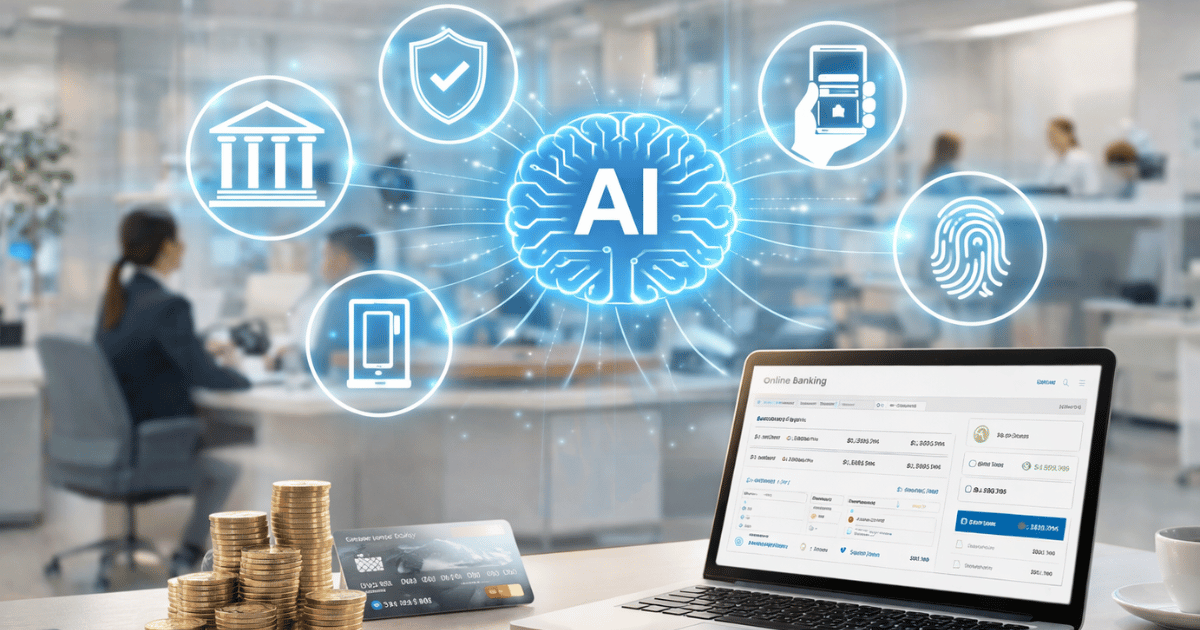
Banking has always been a data-intensive industry. Every transaction, loan application, and customer interaction generates information. The challenge has never been collecting data. It has been using that data effectively at speed and scale.
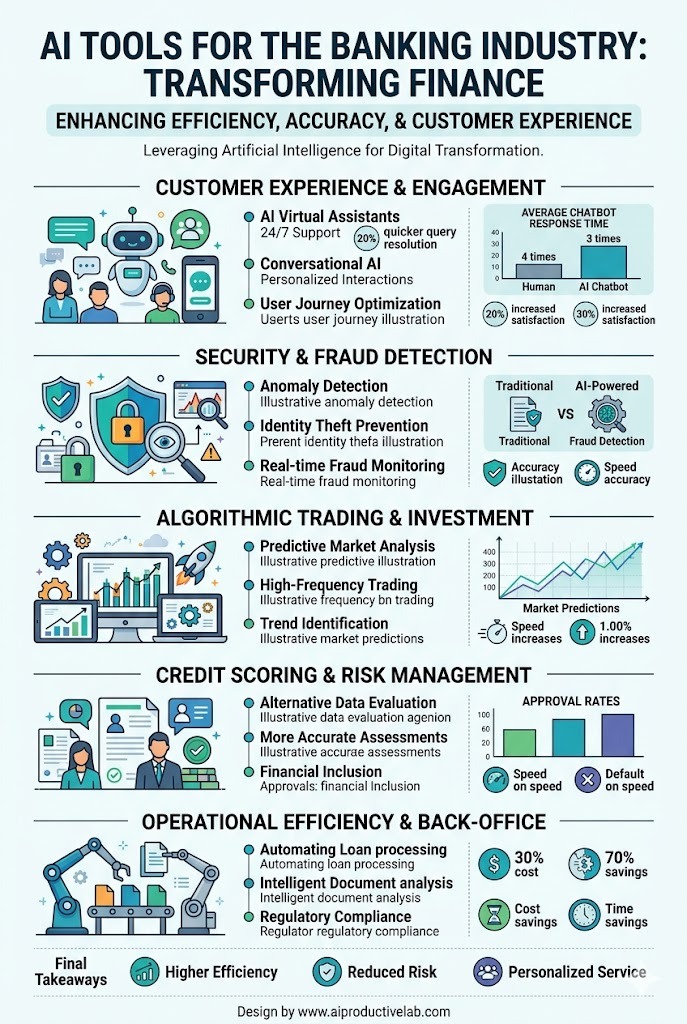
- Real-time AI fraud detection reduces losses and false positives by analyzing behavioral, geolocation, and transaction patterns.
- Conversational AI powers virtual assistants that resolve complex banking queries, cut call center volume, and improve customer satisfaction.
- Machine learning enhances credit underwriting accuracy, expands access to creditworthy borrowers, and supports fair lending compliance.
- Regulatory compliance AI automates KYC and AML monitoring, lowering false positives and easing investigator workloads.
- Successful AI adoption needs data readiness, explainable models, controlled pilots, and cross-functional collaboration to prove measurable outcomes.
AI tools for banking industry solve this problem. They process millions of transactions per second, detect fraud in real time, automate compliance workflows, and deliver personalized customer experiences across digital channels. Manual processes that once required entire departments now run autonomously.
Global banks are projected to spend over 80 billion USD on AI technologies by 2027. This is not speculative investment. It reflects proven returns in fraud prevention, operational efficiency, and customer retention that early adopters have already demonstrated.
Community banks and regional institutions are following suit. Cloud-based AI platforms have lowered the entry barrier, making intelligent banking automation accessible beyond the largest financial institutions.
How AI Is Transforming Core Banking Operations
AI touches nearly every function inside a modern bank. Understanding the key application areas helps clarify which tools deliver the most value.
Fraud detection is the most mature use case. AI fraud detection in banking analyzes transaction patterns, device fingerprints, geolocation data, and behavioral signals to identify suspicious activity before losses occur. These systems adapt to evolving fraud tactics faster than any manual review team.
Customer service is another area seeing rapid transformation. AI-powered customer service banking tools handle routine inquiries through chatbots and virtual assistants. They resolve balance checks, transaction disputes, and product questions instantly, freeing human agents for complex cases.
Credit decisioning benefits significantly from machine learning for banks. AI models assess creditworthiness using broader data inputs than traditional scoring methods. This improves approval accuracy while expanding access to underserved borrowers.
Regulatory compliance AI tools automate know-your-customer checks, anti-money laundering monitoring, and report generation. They reduce compliance costs while improving detection rates for suspicious activities that regulators require banks to catch.
10 AI Tools for Banking Industry Driving Real Results
1. Featurespace
Featurespace leads in real-time fraud prevention using adaptive behavioral analytics. Its ARIC platform monitors every transaction and builds behavioral profiles for each customer. When activity deviates from established patterns, the system flags it instantly.
Major banks and payment networks use Featurespace to detect card fraud, account takeovers, and payment scams. It catches novel fraud types that rule-based systems miss entirely. False positive rates drop significantly, which means fewer legitimate transactions get blocked unnecessarily.
2. Personetics
Personetics powers AI-driven financial insights for some of the world’s largest banks. It analyzes customer transaction data and delivers personalized nudges, spending summaries, and savings recommendations directly within banking apps.
The platform helps banks deepen customer engagement without manual intervention. Customers receive proactive alerts about unusual charges, upcoming bill payments, and opportunities to save. Over 150 million bank customers worldwide interact with Personetics-powered insights daily.
3. Zest AI
Zest AI applies machine learning to credit underwriting. It helps banks and lenders build more accurate credit risk models that evaluate thousands of variables beyond traditional credit scores.
The result is better lending decisions. Approval rates increase for creditworthy borrowers who would otherwise be declined. Default rates decrease because the models identify genuine risk signals that conventional scoring overlooks. AI credit risk assessment through Zest AI also helps banks demonstrate fair lending compliance.
4. Kasisto
Kasisto builds KAI, a conversational AI platform designed specifically for banking. It powers intelligent virtual assistants that handle customer inquiries across mobile apps, websites, and messaging platforms.
KAI understands complex banking queries, not just simple commands. It can explain fee structures, guide customers through loan applications, and provide spending analysis in natural language. Banks using Kasisto report significant reductions in call center volume and improved customer satisfaction scores.
5. ComplyAdvantage
ComplyAdvantage is a regulatory compliance AI tool that automates anti-money laundering screening and transaction monitoring. It uses machine learning to scan customer data against global watchlists, sanctions databases, and adverse media sources in real time.
Traditional compliance systems generate excessive false alerts that overwhelm investigation teams. ComplyAdvantage reduces false positives by up to 70 percent while improving detection accuracy. Banks maintain regulatory standing without drowning compliance staff in manual review work.
6. Darktrace
Darktrace applies self-learning AI to cybersecurity for financial institutions. Its technology detects and responds to cyber threats across banking networks, cloud environments, and customer-facing applications autonomously.
The platform identifies threats that signature-based security tools miss. It learns what normal network behavior looks like and flags deviations in real time. Banks face constant cyberattack attempts, and Darktrace provides a layer of defense that adapts as threats evolve.
7. Temenos AI
Temenos is a global banking software company that embeds AI across its core banking platform. Its AI capabilities span credit scoring, customer segmentation, financial crime detection, and process automation.
Banks running on Temenos gain AI functionality without integrating separate third-party tools. The platform processes data from core banking operations and applies machine learning models that improve continuously. Over 3,000 financial institutions across 150 countries use Temenos technology.
8. Ocrolus
Ocrolus automates financial document analysis using AI. It reads bank statements, tax returns, pay stubs, and mortgage documents with high accuracy. It extracts structured data and performs calculations that loan officers and underwriters would otherwise do manually.
The platform accelerates loan processing from days to hours. It detects document fraud by identifying manipulated figures and inconsistencies across submitted paperwork. Lenders and banks use Ocrolus to speed up origination while strengthening fraud defenses.
9. Symphony AyasdiAI
Symphony AyasdiAI focuses on anti-money laundering and financial crime detection for large banks. Its machine learning platform builds models that identify complex money laundering networks traditional systems cannot detect.
The tool excels at finding hidden connections between accounts, entities, and transactions across massive datasets. It reduces investigation backlogs and helps compliance teams focus on genuinely suspicious activity rather than chasing false leads.
10. Clinc
Clinc develops conversational AI for banking that handles complex, multi-turn customer dialogues. Unlike basic chatbots, Clinc’s technology understands context, follow-up questions, and ambiguous language.
The platform supports voice and text interactions across banking channels. Customers can ask about recent transactions, request transfers, and explore product options in natural conversation. Clinc reduces the need for human agents while maintaining a conversational experience that feels genuinely helpful.
Comparison Table: Selecting the Right Banking AI Tool
| Tool | Primary Function | Best For | Deployment |
|---|---|---|---|
| Featurespace | Real-time fraud detection | Transaction monitoring | Cloud and on-premise |
| Personetics | Customer financial insights | Engagement and retention | Cloud, embedded in apps |
| Zest AI | Credit underwriting | Lending decisions | Cloud |
| Kasisto | Virtual banking assistant | Customer service automation | Cloud, API |
| ComplyAdvantage | AML and compliance screening | Regulatory compliance | Cloud, API |
| Darktrace | Cybersecurity threat detection | IT security teams | Cloud and on-premise |
| Temenos AI | Core banking AI | Full-stack banking | Cloud and on-premise |
| Ocrolus | Document analysis | Loan processing | Cloud, API |
| Symphony AyasdiAI | Financial crime detection | AML investigation teams | Cloud and on-premise |
| Clinc | Conversational AI | Digital banking channels | Cloud, API |
How Banks Should Approach AI Adoption
Successful AI implementation in banking requires more than purchasing software. It demands a clear strategy that aligns technology investments with specific business outcomes.
Begin with high-volume, rule-heavy processes. Compliance screening, document verification, and transaction monitoring offer the fastest returns because they involve repetitive tasks with clear success metrics. These use cases also carry lower implementation risk than customer-facing applications.
Data readiness determines AI effectiveness. Machine learning for banks only works when models receive clean, comprehensive, and well-structured data. Invest in data infrastructure and governance before expecting AI tools to perform at their full potential.
Regulatory alignment is critical at every stage. Banks operate under strict oversight. Every AI model used in credit decisions, fraud detection, or compliance must be explainable and auditable. Choose platforms that provide model transparency and documentation that regulators expect.
Start with a controlled pilot. Deploy AI in one branch, one product line, or one customer segment first. Measure impact against defined KPIs for 90 days. Use those results to build the business case for broader rollout.
Cross-functional collaboration accelerates success. AI projects stall when they sit exclusively within IT departments. Involve compliance officers, relationship managers, and operations leaders from the beginning to ensure tools solve real business problems.
The Competitive Reality Banks Face
Banks that delay AI adoption fall behind in measurable ways. Their fraud losses are higher. Their customer service costs are steeper. Their lending decisions are slower and less accurate. Competitors using intelligent banking automation capture market share by offering faster approvals, better digital experiences, and lower fees.
The technology gap compounds quarterly. AI models improve with more data and usage. Banks that started implementing AI three years ago now operate with significantly more refined models than institutions beginning today. Early movers hold a structural advantage that grows over time.
The window for catching up is narrowing. Customers increasingly expect the instant, personalized experiences that AI-powered banks deliver. Institutions still relying on manual processes risk losing their most valuable customers to digitally advanced competitors.
FAQs
Banks use AI tools to detect fraud, automate compliance checks, improve credit decisions, power virtual assistants, and deliver personalized financial insights to customers.
AI monitors transaction patterns and customer behavior in real time, flagging activities that deviate from normal patterns. It adapts continuously to detect new fraud methods.
Yes. Cloud-based platforms like ComplyAdvantage and Zest AI offer scalable pricing that makes AI accessible to community banks and credit unions, not just large institutions.
AI automates repetitive tasks but does not replace strategic roles. It handles routine inquiries and data processing, allowing bank staff to focus on complex customer relationships and decision-making.
Banks choose AI platforms that offer model explainability, audit trails, and bias testing. Regulators require transparency in how AI influences credit, compliance, and fraud decisions.



 AI/ML Strategy and Consulting
 Data Science And Data Analytics
 Generative AI
 AI Consulting Services
 AI Automation Solutions
 API Integration


